Community Engagement & Public Health


Stan, Clarence, Barry, and the Health Chatter team chat with Julie Brock, owner of Julie Brock Consulting, about community engagement.
Julie is a strategist who helps individuals, teams, and organizations move from ideas to measurable action through human-centered systems. Her work draws on co-design, CliftonStrengths®, Results Based Accountability, and stress management and resiliency—grounded in deep listening, connection-making, and a willingness to disrupt the status quo so people can lead with confidence and purpose. Julie brings experience across K–12 education, workforce development, community-based organizations, business, and higher education, and holds degrees in English and Human Development.
Learn more about Julie Brock and their work at https://juliebrock.net/
Join us for an insightful conversation about community engagement.
Join the conversation at healthchatterpodcast.com
Brought to you in support of Hue-MAN, who is Creating Healthy Communities through Innovative Partnerships.
More about their work can be found at https://www.huemanpartnershipalliance.org/
Research
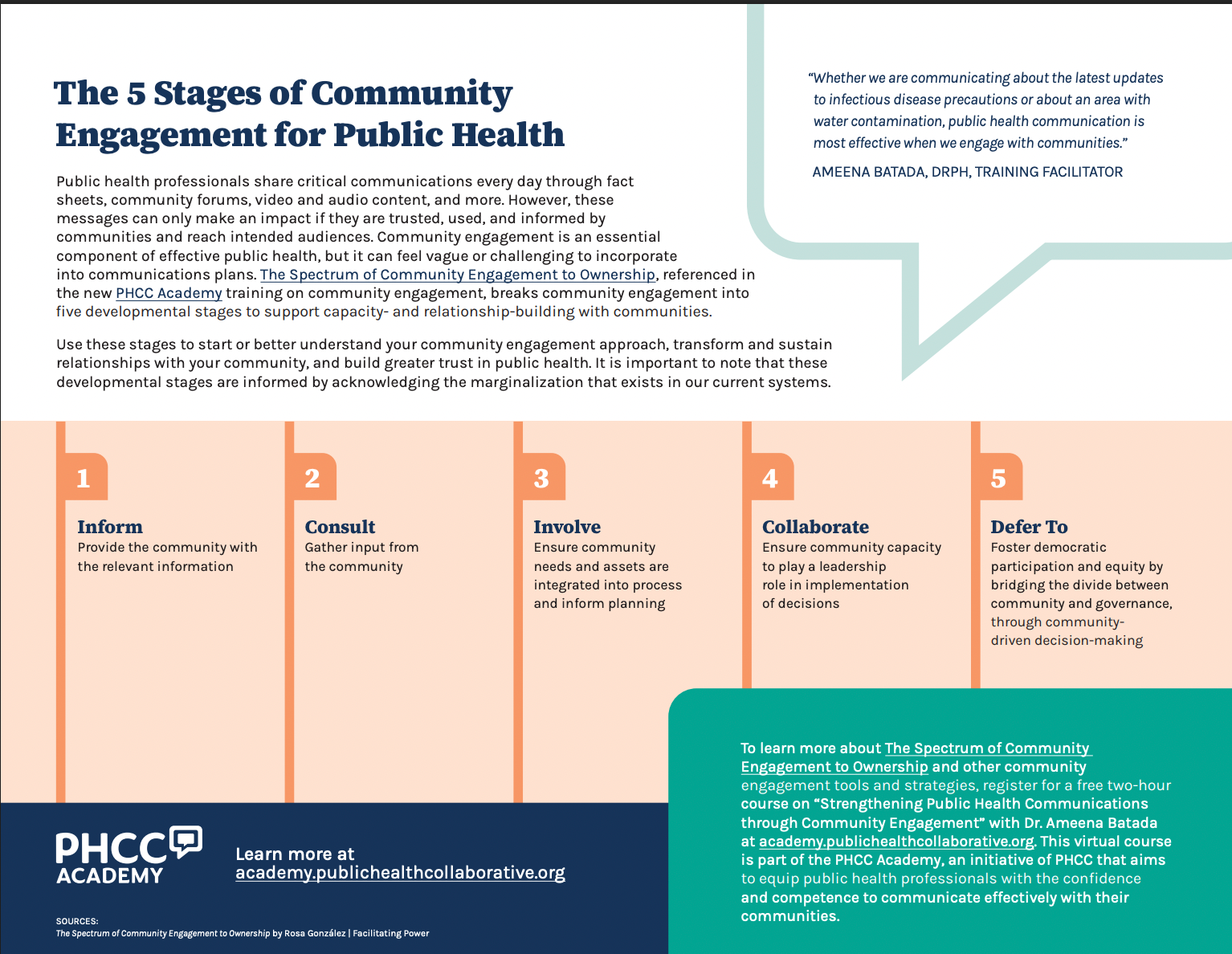
Community engagement is a core aspect of public health: (https://ajph.aphapublications.org/doi/full/10.2105/AJPH.2025.308029)
Go to communities and LISTEN
Empower the community
Use new data to inform the community and accompany discussions with community
Build long term capacity for trustworthiness
Be sincere, flexible, and humble and genuinely listen. The journey to health equity is long and there is much to learn.
Lessons learned from CDC article (https://www.cdc.gov/pcd/issues/2025/25_0189.htm)
Go to communities to learn their perspectives, strengths, values, and priorities. This is central to intentional relationship-building, reflecting the value of community members and groups as central to planning, implementing, evaluating, and sustaining programs and research that matters. Despite funding challenges, this practice is central to trust, must be built over time, and should not be rooted in the acquisition or administration of a grant.
Amplify and credit the community wisdom central to ideation, process, implementation, evaluation, and recommendations, including investigator status, compensation, co-authorship, co-presentation, and co-branding.
Address institutional and organizational barriers to and needed investments in community-engaged prevention practice and research. Barriers may reflect deep-seated administrative structures that threaten efficiency and trust even among the most well-meaning, mission-aligned partners.
Partner with health care, social service, business, faith, and nongovernment organizations to address social and political factors associated with health and health care. These potential partners are often underused, despite their services and ability to influence health priorities such as housing, workforce development, food access, and primary health care.
Support community-led projects and infrastructure central to sustained success. Mechanisms that position communities as senior or principal investigators of prevention programs and research are essential to powering (not empowering) their leadership and sustaining their programs. This value and practice must be bolstered by partnerships and resources for rigorous and robust data collection and analysis to demonstrate impact and outcomes.
Address and eradicate rampant health misinformation and disinformation by reimagining public health communication, in partnership with community influencers, resulting in messages that are not only accurate but attend to social motivation, lived experiences, and trusted sources across the spectrum of mass and social media communication.
Advocate for community-led public health improvement. Community-informed data systems, metrics, and networks should not only drive responsive research, practice, and clinical care but also be the change that dismantles systemic and structural barriers to health through local, regional, and national policy.
Practice the values of listening to understand, cultural humility to translate, and trustworthiness to build and trust.
Respect community strengths and avoid the idea that communities lack resources and need the preconceived solutions of outside groups to solve problems within the community.
This is a long-form transcription of the Health Chatter podcast episode on Community Engagement and Public Health.
Health Chatter: Community Engagement and Public Health
Stanton Shanedling: Hello, everybody! Welcome to Health Chatter. Today's show is on community engagement and public health. This is an interesting topic, especially for those of us who have been involved in public health for our entire careers; we really embrace the idea of community engagement. We have a wonderful guest with us today whom I will introduce in just a moment.
We also have a wonderful crew that helps make these shows successful and interesting, getting them out to the listening audience in perfect form: Maddy Levine-Wolf, Erin Collins (who is also recording today), Deondra Howard (who did the background research), Matthew Campbell (our production guru), and Sheridan Nygard (who handles marketing and transcription). They are second to none.
My co-host is Clarence Jones, who has been with the show since day one. He is a great colleague, and we have both been involved in community engagement activities ourselves. We also have Dr. Barry Baines, who gives us a medical twist on all of our shows.
Today, we have Julie Brock with us. When I read about the ideas of community engagement, it really rang true for me, but having an expert talk about it is even better. Julie has worked across the gamut: K-12 education, workforce development, community-based organizations, business, and higher education. She earned her Bachelor of Arts in English from the University of Oregon, her Secondary Teaching Certification from Metro State College of Denver, and a Master of Arts in Human Development from St. Mary’s University of Minnesota. Julie, thank you for being with us.
Clarence Jones: Hi, Julie, welcome to the program. In reading about you, it mentions that you are a strategist at heart when it comes to community engagement. Can you start by talking about that?
Julie Brock: Absolutely. When we think about policy changes or anything within public health that affects the public, if we just "throw spaghetti at the wall," it isn't good for the people who are suffering. We have to start thinking about how we are systematizing human-centered policy work. When I say I’m a strategist at heart, I’m thinking about the "beating hearts" of people—thinking about how we want to bring people along.
When we think about policy, it’s those beating hearts that are affected. We have to ask: who is the end user of this policy? Who is the beneficiary of the program? Are we designing that from the beginning with the people who will actually be using it so that it actually works? Instead of making decisions out of an office, we must engage the community and strategically think about what this means for different communities from the very beginning.
Clarence Jones: What are the challenges of this work? There are perceptions about community, policies, and government. What are the hurdles in your space?
Julie Brock: Trust and time. Trust is number one. When we think about policy change or programmatic implementation, our institutions are often on a timeline—for example, a goal for the first quarter of 2026. Well, humans don't work that way. The biggest challenge is managing expectations and saying, "You can hit your arbitrary time goal, but you won't have anyone using your program". If you want people using your program, you have to start building trust yesterday.
There are misconceptions both ways about what it means to be in a community at large versus "my community". "My community" is where trust is built. If someone I trust in my community says a program is valid and will work for me, I’m much more open to trying it. But if someone from the government or a non-profit knocks on my door and says, "We have this great program," I don't know them.
Clarence Jones: Talk about the misconception of community. What do people really think about it?
Julie Brock: It depends on where you are speaking from. If I’m speaking from a county vantage point, I might think of the whole county as "the community". But that "Big C" Community is made up of smaller municipalities, demographics, and eventually micro-circles of people who actually hang out together. That circle is the "trusted circle".
The misconception occurs when the county says, "We have a healthy community," but people in specific micro-communities are saying, "I can't afford healthcare, I need mental health services but I’m on a waiting list, or I can't afford the co-pay". We have to be crystal clear about who we are talking about. If we use a "Big County Community Blanket," we won't reach the people who actually need the program.
Clarence Jones: You mentioned "human-centered design" and "co-design." For people who are used to the traditional way of making policy—where experts sit in a room and decide what’s best—can you explain what that actually looks like in practice?
Julie Brock: It's a complete shift in power. Traditional design is "top-down." Co-design is "side-by-side." It starts with the radical idea that the person experiencing the problem is the expert on that problem. I might have a master's degree in human development, but I am not an expert on what it's like to be a single mother in a specific neighborhood trying to find childcare at 10:00 PM. She is the expert.
In co-design, we bring those "experts by experience" into the room from day one. We don't just ask them for feedback on a plan we already finished; we ask them to help us write the plan. We use tools like journey mapping, where we walk through a day in their life to see where the friction points are. We prototype ideas—meaning we try a small, low-stakes version of a program—and we let the community tell us why it failed or how it could be better. It prevents us from spending millions of dollars on a "perfect" system that nobody wants to use.
Stanton Shanedling: Julie, I'm thinking about the "Spectrum of Engagement." Often, organizations think they are engaging the community when they are actually just informing them. Can you talk about that distinction?
Julie Brock: That is such a vital point. There is a framework called the IAP2 Spectrum of Public Participation. On the far left, you have "Inform," which is just telling people what you decided—like a flyer or a press release. Then you move to "Consult," where you ask for feedback but still hold all the power.
The goal for true public health equity is to move toward the right side of that spectrum: "Collaborate" and "Empower." In the "Empower" stage, the community makes the final decision. In public health, we often get stuck at "Consult." We hold a town hall, people vent their frustrations, we say "thank you for your input," and then we go back to our offices and do what we were going to do anyway. That actually erodes trust. If you aren't ready to let the community influence the outcome, don't ask them for their opinion. It’s better to be honest about the limitations of their influence than to fake engagement.
Clarence Jones: Let’s talk about youth engagement. Often, we talk about young people, but we don't talk to them. How do you bring youth into these strategic conversations?
Julie Brock: Youth are the most underutilized resource in community engagement. They have the highest stake in the future, and they are often the most honest about what isn't working. When engaging youth, you have to meet them where they are. You don't ask a 16-year-old to come to a 10:00 AM subcommittee meeting at the courthouse.
You go to the parks, the schools, or the digital spaces where they already hang out. We also have to compensate them for their time. Their expertise is just as valuable as the consultant we’re paying $200 an hour. When we treated youth as partners in a recent park project, they didn't just ask for better basketball courts; they asked for lighting and safety features that the adults hadn't even considered because the adults aren't in the park after dark.
Dr. Barry Baines: Julie, from a medical perspective, I see this a lot with health literacy. We give patients these complex instructions that they don't follow, and we call it "non-compliance." But maybe the instructions were just poorly designed for their life.
Julie Brock: Exactly, Dr. Baines! That is a perfect example of a design failure. If a patient isn't taking their medication, the "human-centered" question isn't "Why aren't they listening?" it's "What is the barrier in their life?" Is the bottle too hard to open? Is the instruction manual written at a college reading level when they speak English as a second language? Or do they have to choose between the co-pay and groceries? When you engage the patient as a co-designer of their own care plan, the "compliance" rates skyrocket because the plan actually fits their reality.
Dr. Barry Baines: Julie, building on what you've said about the time it takes to build trust, I have a question about our current environment. It seems that in my years on this rock, the attention spans of people have really shortened. In our society now, it feels like everyone just thinks short-term. People have a lot of difficulty seeing something progress at a snail's pace rather than as a sprint—the 100-yard dash where your arm is fixed, as opposed to the long-term work of getting blood pressure under control . How do these societal shifts toward short attention spans feed into the progress of community engagement and public health?
Julie Brock: That is such a great and multifaceted question . One of the things I focus on—beyond just community engagement—is working with organizations on human-centered systems. We have to ask: what does it look like when we build a system based on the "beating hearts" that use them, operate them, and pay for them?
If we flip the script and stop saying, "We have people hurting, so here is a program to help them not hurt so that our data looks better," we find more success . Data improvement isn't motivating to someone who is actually in pain. In the United States, we often treat the symptoms because they are easy, but we don't treat the root cause because it is hard and it takes time .
Stanton Shanedling: I've said this throughout my career: public health isn't as "sexy" as medical intervention. With a medical intervention, you have a broken arm, you get a cast, and you get better. In public health, we might focus on something like fall prevention. It’s harder for people to get their heads around that long-term prevention compared to an immediate cure .
Julie Brock: Exactly. We are the only animals that have to be "taught how to human," and yet we don't often teach things like brain function or the power of the organ in our skulls . I’ve become fascinated with how "humans human"—what causes people to harm, and what would it take for us to just see that beating heart in one another?
Clarence Jones: That is a powerful place to leave it. Julie, if people want to learn more about your work or human-centered design, where can they find you?
Julie Brock: You can find me on LinkedIn or through my strategy work. I’m always happy to talk about how we can make our systems more human.
Stanton Shanedling: This has been a truly insightful show. Thank you so much, Julie, for being with us and sharing your expertise. I also want to mention our partnership with Human Partnership, a community health organization that does wonderful things in our community .
To our crew—Maddy, Eron, Deondra, Matthew, and Sheridan—thank you for your hard work behind the scenes . And to our audience, thank you for listening. We hope this gave you a new perspective on what it means to truly engage with your community.
Until next time, this is Stanton Shanedling. Stay safe, stay healthy, and keep health chatting away!


