Retirement & Health
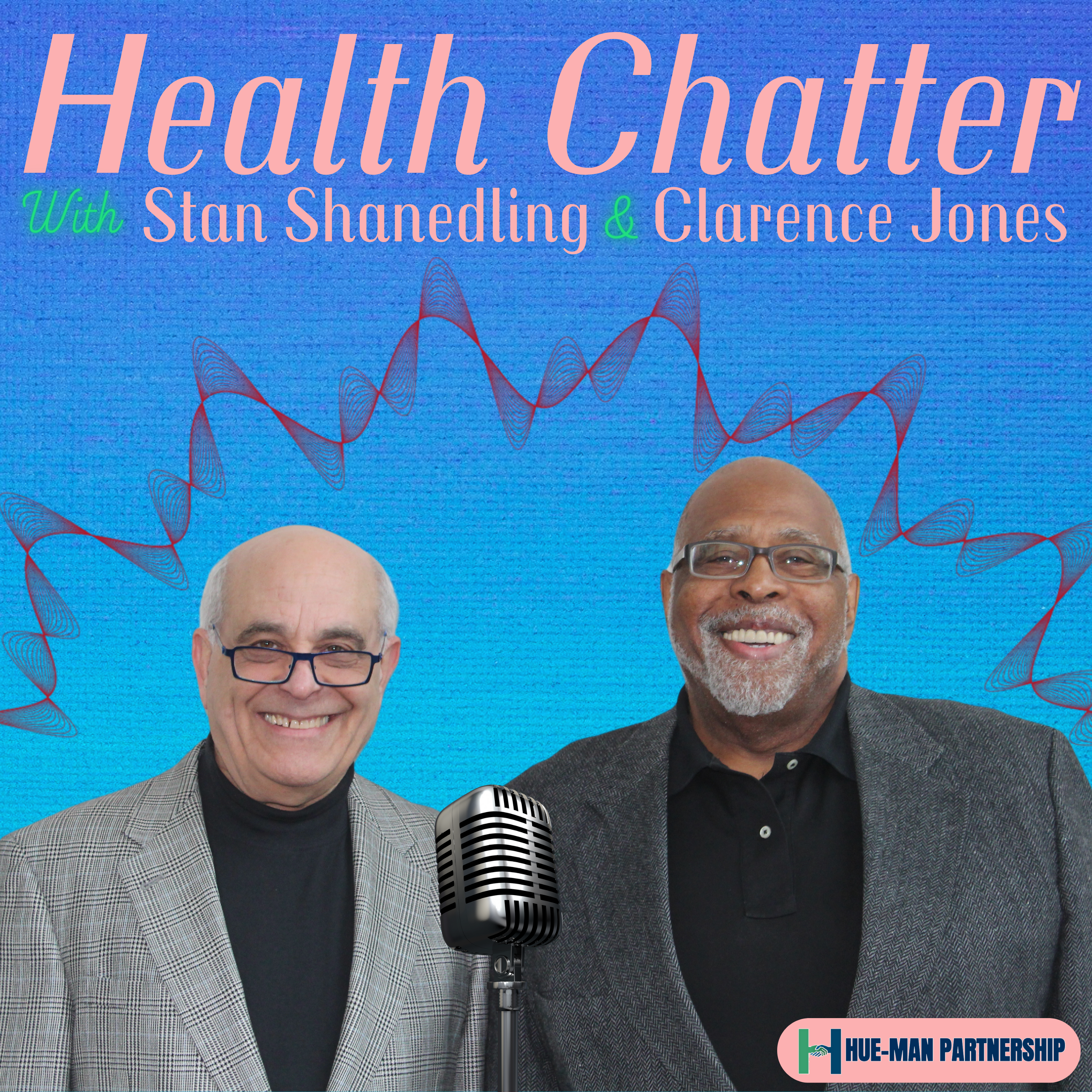


Stan, Clarence, Barry, and the Health Chatter team chat about retirement and health.
Join the conversation at healthchatterpodcast.com
Brought to you in support of Hue-MAN, who is Creating Healthy Communities through Innovative Partnerships.
More about their work can be found at https://www.huemanpartnershipalliance.org/
Stanton Shanedling: Good morning, everybody! Welcome to Health Chatter. Today's show is on retirement and health. Interesting tidbits of information I'm sure will come your way from our illustrious crew.
When we talk about retirement, it's going to be a little bit of a perspective thing, because, you know, I'm retired, Barry's retired, Clarence is… retired for all intents and purposes. So it'll be interesting perspectives on what we've learned, so stay tuned. We have a great crew.
I always like to identify them and let everybody know that without them, these shows would not be as successful and as interesting. So, Matty Levine-Wolf, Aaron Collins, DeAndra Howard, Matthew Campbell, Sheridan Nygaard are second to none. They provide research, they do our production, they do our recording, and help keep Barry, Clarence, and me in line. So, thank you to all of you. They're really, really great colleagues and friends as well.
Got Clarence as my co-host on the show. We've been doing this since day one. Thank you, Clarence, for being with us all the time. Of course, Barry Baines is our medical advisor and provides some wonderful insights as well. Thanks to you two as well.
Human Partnership is our sponsor. Check them out. It's a good community health organization. Every time I talk to Clarence, whether it's just texting or a quick phone call, he's always telling me about something creative that they're doing. It's really cool. So, check them out at Hughman.com.
And check us out at healthchatterpodcast.com for all the shows. Since day one, all the shows are transcribed, and you can also see background research for our shows.
Alright, so retirement… I don't know about you, Barry and Clarence, but I've been thinking about this adjustment that retirement takes. So, what I thought I would do is start out with this question: How did you know that it was time for you to retire?
Barry Baines: Well, take away… I'm going to go off on some… they're not really tangents; they're very relevant. Because what you're talking about is only one option for retirement: when you decide to retire. That actually makes a difference compared to people who were forced into retirement when they didn't want to.
Stanton Shanedling: Correct. And those have impacts on health.
Barry Baines: Yeah. So, to answer your question… well, there are a couple of things. You get to a certain age and start to think about things differently, and start making a shift. Are there other things I’d want to do? I will say for physicians, retirement tends to be more difficult because so much of their identity is tied up in being a physician, caring for patients, and things like that.
I've known colleagues who… because they’re so busy doing their doctor thing, they haven't had time to develop other interests. That's actually one of the things that provides a safety net for me. I was a very devoted hospice physician, family doc, and fortunately for me, I developed other interests.
For me, it was having someone I could pass the baton to, the younger generation. But, to be honest, one of the hospice programs I was a medical director for… the organization decided hospice didn't fit their mission anymore and effectively sold it off. So, part of my job was forced into retirement because there was no reason to have me as a medical director.
The other part, I just decided to retire. I had a good colleague I could pass the baton to, and there were lots of things that interested me. My transition was good. I still keep my toe in, even working with Clarence, Stan, and the rest of the crew. I feel like I'm not totally retired because they keep me on my toes. They do great research, and I pick up on things, which keeps me sharp.
But that decision wasn’t because of health reasons. I chose to do it so I could devote myself to doing things I really want to do. Often, when we work, we do things we have to do.
Clarence Jones: Thank you.
Stanton Shanedling: How about you?
Barry Baines: Life satisfaction changes.
Stanton Shanedling: Yeah. Claire, what's your personal perspective on it?
Clarence Jones: Well, Barry, you and I have very similar retirement events in our lives, depending on how you define retirement. Mine was somewhat… not necessarily welcomed. People decide they want to go in a different direction, so I retired from that position, but not from the work.
Some people say, "You’ve worked so many years; now you’re 62, 65, 67, now you’re retired." I go along with that, but I’m still doing what I was always doing. That’s what’s interesting about retirement. When I was growing up, people worked to retire, but many times after retirement, they didn’t have other passions or activities, and sometimes they passed away a few years later.
For me, retirement and health mean being conscious at this stage of life to be healthier. This morning, I tried hydrogen water because someone told me it was good. Retirement does not mean stagnation. You can’t just sit on the beach for a couple of years—that’s not a very fruitful life. That’s my personal opinion.
Stanton Shanedling: I’ll pick up a couple of thoughts you brought out. For me, at the State Health Department, I saw young talent and thought, it’s time for them to carry the torch, like Barry said. When I retired, I went through a process on knowledge transfer—giving others what I know so they can proceed.
Retirement doesn’t mean cutting the cord. It’s taking a different path or assuming different activities, and that can be healthy. People often ask, “Now that you’re retired, what are you doing?” It’s okay to do nothing at first; some people need time to adjust to a new lifestyle.
Clarence Jones: I want to interject. You talked about recognizing younger people coming along and creating a pathway for them. I think it’s important to talk about legacy. You can work all your life, but what kind of legacy do you leave? When you have a legacy or an investment in someone coming along, you don’t really retire—you shift to mentoring. That will make you healthier mentally, socially, and it helps them too.
Stanton Shanedling: Another point is what feels good. When you retire, what feels good might be something simple, like reading a book with a cup of coffee. Time becomes almost sacred.
Barry Baines: Research shows retirement has positive and negative effects. Positive effects include improved mental health and life satisfaction, being able to do things you enjoy, and engaging in activities that leave a meaningful legacy. Many retirees volunteer, which is another positive.
Negatives include decreased physical functioning, an increase in chronic disease as we age, and higher mortality for those who retire on time without staying active. Whether retirement is voluntary or involuntary also matters. Even though retirement can be positive, it’s a stressor, ranking tenth on the Holmes-Rahe Stress Scale.
Clarence Jones: Retirement is not always what we fantasize. Life happens. It’s important to have other passions and activities. Very few of us live the retirement we think we will.
Stanton Shanedling: Murphy, my dog, is agreeing with you in the background. Retirement gives time to reflect on personal and professional life. Age can impact readiness; it’s worth exploring even early retirement. I remember retirement courses asking, “What are you going to do?” Top answers were spending time with family and travel. But health readiness matters; you can’t just jump into strenuous activities.
Volunteering is also important. At Methodist Hospital, most volunteers are over 60, showing connection matters. Connections with colleagues change after retirement; now conversations are more about life than work.
Loneliness can be a challenge as you adjust, especially if you have a spouse. Retirement is an adjustment not just for you but for those around you.
Clarence Jones: Absolutely. My wife and I both had busy lives. When I retired, expectations shifted. Later, when she retired, we had to learn to communicate again in a new context. Health of the relationship matters; you want these years to be good years, and that requires attention.
Barry Baines: Exactly. The University of California, Berkeley Aging Center highlights that spending more time together requires learning to communicate in a new way. Retirement affects relationships and overall health.
Barry Baines: Evolve our habits and doing things in a certain way, which is a workplace, not the home place. And those things, you know, that they talk about with retirement, is, again, if you're a couple, that you need to talk about these things—the tasks around the house—instead of getting in each other's way, to kind of be a team and work together. Now, for couples that have had children, oftentimes that was done earlier in the relationship, where there’s not enough time to focus, to figure out who's gonna do what. But in retirement, it becomes very important to do that. So that was really good. I liked hearing that.
Stanton Shanedling: Well, let me tell you a little story. I had mentioned that for a lot of people who retire, they hope to be able to spend more time with family. A week and a half ago, I went out east to visit my son, his wife, and my two grandkids. Anyway, it's really interesting when you, as a retired person, embed yourself in their lifestyle. It's an adjustment for those that you're connecting with, family-wise. For instance, my son is working, my daughter-in-law's working, my grandson's going to school, my granddaughter's going to preschool, they've got after-school activities—you wouldn't believe. And then there's Grandpa over here. It's kind of like, okay, I'm plotting along with you everywhere you go, but it's truly a different family dynamic when you're retired and you want to link with your family.
The next thing I was going to talk about is energy.
Clarence Jones: You know, what kind of energy does it take?
Stanton Shanedling: To do the different things. Does it mean that when you're retired, because of your age and everything else, you're just slowing down? Or for some people, they get more energetic. They do more things. For instance, I can say that I didn't go to a health club anywhere near as much as I am doing now being retired. Because, frankly, before, finding the time or the energy after working all day was more difficult. But now I do, and it's linked to two things: one is health, and the other is socialization—keeping connected with people.
So the other question I want to ask you guys—Clarence, you can take it—are you happy in your retirement so far?
Clarence Jones: Okay. I think, like you were talking about energy, when you're working, your energy is focused on performing at a certain level or responsibilities, right? And so you find a lot of your energy there. I do believe that when you retire, you have to refocus that energy into some other methods of output. Until you can refocus on whatever those activities are, you do have sometimes a disconnection as it relates to energy. Am I happier now that I'm retired? I think I am, but that's only because of the things we've been talking about—learning how to communicate, accepting that things are going to be different. I don't get up from 8 to 5 to go into a place. I've had a chance to read a little more. I've been willing to punt a lot in retirement, which is to say, some of the things I thought I would do, I can't do like I thought I could, and I don't have the energy to do a lot of things I did when I was younger. But the reality is, it's not bad.
Stanton Shanedling: Yeah, yeah.
Stanton Shanedling: Barry, what do you think? On the happiness scale, what do you think?
Barry Baines: I would say, in general, probably a 7 or 8, which is okay. It's not all happiness, because happiness comes in different forms. One form is happiness from physical pleasure, but there's also happiness from meaningful things that you do. That's where the balance comes in. The balance changes; happiness and unhappiness rise and fall depending on what you go through. Oftentimes, if you're not unhappy at times, you lose out on some of the real enjoyment of happiness when you are happy.
There are parts of my life where I'm less happy, in part because of the work I used to do in hospice, which was very meaningful. But moving on, math tutoring and helping fifth graders gives me a lot of happiness. I just love helping the kids when I can, and it's always a highlight of my day. So, it's not a simple yes or no—certain parts, yes, I'm happier; other parts, honestly, not as happy. But on balance, if I look at the big picture, I’m glad that I am retired now to the extent that I am, and I'm still doing stuff here with you folks.
Stanton Shanedling: Well, happiness ebbs and flows. There are things that make you happy, and you embrace them. I think embracing them in retirement is at a different level than before. I personally seek things that make me happy. Before, I didn’t think about that as much. Now, it's more of a personal thing going forward.
For instance, when I was overseas in June, I was putzing around with my iPhone to make sure I could take good pictures. I realized I should just take a class on how to get the most out of an iPhone for pictures, and I could just do that. Before, I would have thought, "Where am I going to fit this into everything else?" Whereas, as you retire, your flexibility affords you opportunities to do different things. Just being able to do things you weren't able to before is healthy.
Barry, you mentioned as you get older, health sometimes dictates slowing down and retiring to preserve it. Did you run into that with patients?
Barry Baines: Yes, but it’s complex. I never felt that because they retired, they became more sick, or got healthier necessarily. Sometimes, when people leave toxic environments, it can be a release—they can be more themselves, which improves mental health and life satisfaction. Aging also brings chronic illnesses you can’t turn back. Physical activity is important—it helps everything. You don’t have to become an Olympic athlete, just stay active.
Stanton Shanedling: Yeah.
Barry Baines: People who plan and have interests find retirement a big boon. People without outside interests need help developing them. My best friend, a psychiatrist, has his life tied up in his practice. He told me he’s afraid of retiring because he doesn’t know what he’ll do.
Stanton Shanedling: I want to briefly touch on finances. You need to be okay financially moving forward—savings, Social Security, and health coverage, whether Medicare or supplemental plans. Navigating all this becomes a project in itself. Technology is another important aspect to stay on top of in retirement.
Barry Baines: Yes, finances and health insurance are among the top things that determine health in retirement.
Clarence Jones: It's funny, in retirement, you get discounts—usually at fast food or movie theaters. Sometimes the benefits aren’t necessarily the healthiest choices, but it’s something. I also take my car for a car wash on Tuesday for a senior discount.
Stanton Shanedling: Barry, last thoughts?
Barry Baines: Retirement has positives and negatives. The number one thing is planning what you’re going to do after retirement—connections, interests, meaningful activities. It’s okay to take some time off to recharge, but not for two years. Move forward and focus on purposeful activities—that’s key to a happier, healthier retirement.
Stanton Shanedling: Clarence?
Clarence Jones: I hope this discussion on health provides insight or information for people retiring or already retired. Retirement and health are really connected, and as you get older, things change. Planning helps you feel good about yourself.
Stanton Shanedling: You have to be true to yourself—connect with yourself differently, but remain true to yourself. If you need to relax, do it. If you need to be active, do it. Staying connected with friends, colleagues, and your support system is vital in retirement.
Thanks, guys. This has been insightful. To our audience, stay tuned for great shows coming up. In the meantime, keep health chatting away.


