Psychological Determinants of Health Behaviors with Dr. Stephanie Hooker


Stan, Clarence, Barry, & the Health Chatter team chat with Dr. Stephanie Hooker on the psychological determinants of health behaviors.
Dr. Stephanie Hooker is a Senior Research Investigator in behavioral and clinical health research at HealthPartners Institute and an adjunct assistant professor at the University of Minnesota Medical School. Her work focuses on psychosocial factors that influence health behaviors and chronic disease outcomes, with particular emphasis on meaning and purpose in life, patient engagement, and intervention development. She collaborates across health systems to design, evaluate, and translate evidence-based behavioral interventions into real-world care.
Learn more about Dr. Hooker's work here.
Join the conversation at healthchatterpodcast.com
Brought to you in support of Hue-MAN, who is Creating Healthy Communities through Innovative Partnerships.
More about their work can be found at https://www.huemanpartnershipalliance.org/
Research
What are determinants of health?
The determinants of health include: the social and economic environment, the physical environment, and the person’s individual characteristics and behaviours
-
Income and social status - higher income and social status are linked to better health. The greater the gap between the richest and poorest people, the greater the differences in health.
-
Education – low education levels are linked with poor health, more stress and lower self-confidence.
-
Physical environment – safe water and clean air, healthy workplaces, safe houses, communities and roads all contribute to good health. Employment and working conditions – people in employment are healthier, particularly those who have more control over their working conditions
-
Social support networks – greater support from families, friends and communities is linked to better health. Culture - customs and traditions, and the beliefs of the family and community all affect health.
-
Genetics - inheritance plays a part in determining lifespan, healthiness and the likelihood of developing certain illnesses. Personal behaviour and coping skills – balanced eating, keeping active, smoking, drinking, and how we deal with life’s stresses and challenges all affect health.
-
Health services - access and use of services that prevent and treat disease influences health
-
Gender - Men and women suffer from different types of diseases at different ages.
Psychological Determinants of Health Behaviors
-
Behavior change techniques methods or strategies adopted in interventions designed to change behavior through activation of, or change in, one or more theory-based psychological determinants
-
Dual-phase theories theories specifying separate phases of action: a motivational phase involving intention formation and an action or volitional phase involving intention enactment
-
Dual-process theories theories specifying separate but interacting action processes: a reasoned, deliberative process governing intentional action and an implicit, nonconscious process involved in impulsive action
-
Effect relationship between a psychological determinant and an outcome (e.g., health behavior), often expressed as directional and causal or deterministic
-
Health protection behaviors actions that offer protection from illness or adverse health conditions or promote good health (e.g., physical activity participation, healthy eating)
-
Health risk behaviors actions that present an increased risk to health (e.g., smoking, excess alcohol consumption)
-
Implicit cognition a psychological construct representing nonconscious, automatic processes implicated in behavioral performance and surmised to affect behavior beyond individuals’ awareness
-
Mechanism of action process by which behavior change techniques affect change in health behaviors through activation of, or change in, psychological determinants
-
Nomological network specified pattern of theory-stipulated associations or effects among psychological determinants and outcomes
-
Psychological determinant psychological entity or construct representing a mental process implicated in, or deterministic of, a psychological or behavioral outcome
-
Psychological mechanism mental process implied or represented by effects among determinants and outcomes (e.g., health behavior)
-
Psychological theory a set of propositional statements based on prior evidence summarizing current knowledge on associations between variables (e.g., psychological determinants) and outcomes (e.g., health behavior)
-
Social cognition theories theories that assume behavior is the consequence of reasoned processing of social information regarding future behavioral performance
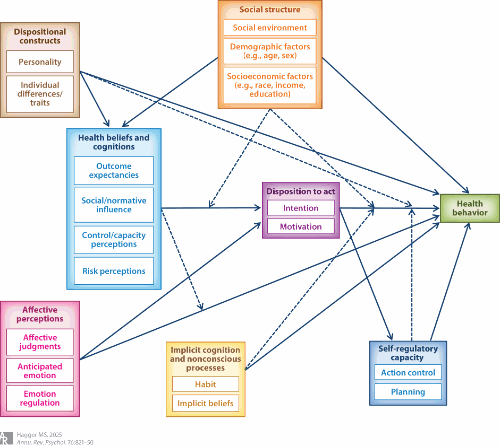
Diagram illustrating theory-stipulated relations among core groups of psychological and social structural determinants and health behavior based on a review of classification research.
References
https://www.who.int/news-room/questions-and-answers/item/determinants-of-health
https://doi.org/10.1146/annurev-psych-020124-114222
Introduction
Stanton Shanedling: Hello, everybody! Welcome to Health Chatter. We have a great show today, a very interesting show. It's actually a subject that's of certain interest to me, for sure: Psychological Determinants of health behavior. We have a great guest, and we'll get to her in a second. We've got a wonderful crew. As always, Maddy Levine-Wolf, who's on a little bit of a sabbatical from the show, but she'll be connecting with us down the road. Erin Collins, Deondra Howard, and Ariana Tardoff are our researchers that put together some background ideas for our shows, so thank you to them. Sheridan Nygard also does some research for us and transcribes our shows. Matthew Campbell is, I call him our production guru. He records our shows and gets them out to you, the listening audience. So this is great, really a wonderful background crew, second to none, and it really makes our job of getting the shows out to you a lot easier, so thanks, everybody. Dr. Barry Baines is our medical advisor. He provides the great balance between medicine and public health. And then, of course, Clarence Jones, who I always feel like I need to give him a bear hug, because we've been doing this for a while now, and it's been fun. So, Clarence, thanks, as always. Human Partnership is our sponsor for these shows. It's a community health organization, and actually probably links to a lot of these things that we're going to be talking about today, for sure. So thanks to them, you can check them out at humanpartnershipalliance.org, and check us out at Health Chatter Podcast. You can read the transcripts of the shows, and also see all the shows that we have done in the past up to this point. So, thanks to everybody.
Today's show: Psychological Determinants of Health Behaviors. You know, I'll tell you, I've read Dr. Stephanie Hooker's bio, and I could keep going on and on. I mean, it's really interesting things. She's a Senior Research Investigator in Behavioral and Clinical Health Research at Health Partners Institute here in the Twin Cities of Minneapolis and St. Paul, and an Adjunct Assistant Professor at the University of Minnesota Medical School. Her work focuses, per her bio here, on psychosocial factors that influence health behaviors and chronic disease outcomes. Now, I'm going to add to this, because Tom Kotke, who has been on our show before addressing a variety of different public health issues, sings her praises. And he really thinks that this is kind of the… maybe even a key aspect to our health going forward. So, Stephanie, thank you so much for being with us today. Greatly appreciate it.
Clarence Jones: And Stan, I'd like to add to those accolades. I told Dr. Stephanie this before: I have watched her and observed her for many years in some other organizations and activities, and she is phenomenal. You know, very quiet, but she knows her stuff, and so I'm very glad that we have the opportunity to have her on our show.
Stanton Shanedling: And she's got a great smile. So, alright, so let's get going here. Let's talk about these psychological determinants of health behavior. So maybe Stephanie can start us out by putting a definitional criteria around this a little bit so that the audience knows what we're truly talking about.
Defining Psychosocial Determinants of Health
Stephanie Hooker: Sure. So, first, I'll just say thank you for having me, and thank you for the accolades. I was smiling, and I know people can't see my smile, but yes, thank you for having me. Since this is my area of research and what I focus on, when we're talking about psychological or psychosocial determinants of health behaviors, we're really talking about what are the things that drive people to act in healthy or unhealthy ways, right?
We all engage in a lot of different health behaviors. That includes things like exercise, the way we eat, or what foods we consume. It can be health risk behaviors, like tobacco or alcohol, or even brushing our teeth. Like, there's a lot of different things we do that maintain or can harm our health, essentially. And so when we talk about those determinants, we're trying to understand what are the things that actually drive people to act in those ways.
They can be psychological things that happen inside the mind. They could be things like motivation—like, how much do you actually want to do this? It could be things like belief in your capability, or self-efficacy. So, how much do I think I can actually do this? Especially when people are adopting new behaviors, not feeling like you have the knowledge or the understanding of how to do a behavior can be a big barrier.
There's also external factors that can drive whether or not people engage in these behaviors. One, do they have the opportunity? Like, do they have access to safe spaces to exercise or to walk, for example? Or do they have external stressors that are impacting their ability to engage in these behaviors? For example, if people have very busy schedules, or they're struggling just to meet their basic needs, these sorts of behaviors can be more challenging for people to engage in. So when we're talking about the psychosocial determinants, we're talking about all these factors, because there are multiple things that influence whether or not somebody's going to engage in any given behavior on any given day.
Life Transitions and Childhood Modeling
Stanton Shanedling: So let me ask you something. You know, I've read through some of this information that our background crew put together, and my question is, do these things, these psychological determinants, do they change as we age?
Stephanie Hooker: I think they can, for sure. I think they change with experience and things that are affecting people's lives. A good example is retirement. That's a transitional period in life, and so sometimes when people are transitioning into retirement, their whole schedules and lives change. Prior to retirement, your life kind of revolved around your work schedule and things that you're doing to kind of maintain your work-life balance. And then in retirement, people kind of generally gain a lot more free time. Their sleep schedules can get off just because they maybe don't have to get up anymore at a certain time of day. The extent that they're engaging in some external activities might change, right? They might have more time to engage in hobbies, or to do exercise, or things like that. So they change because, over time, our awareness of our health also changes. As we age, we also, unfortunately, become more aware that our bodies are aging, and therefore, you know, you might want to engage in healthier behaviors to help prolong a healthy life. And so, yes, I would say they definitely can change over the course of the lifespan.
Stanton Shanedling: You know, it's interesting you brought up the idea of brushing your teeth. I mean, obviously you're not born knowing that. This is a behavior that you do theoretically for the rest of your life. That and, for our dentists that are listening, that and flossing as well, right?
Stephanie Hooker: Right, yes, brushing and flossing. But you're right, those are not inherent behaviors that we are born knowing that we have to do. A lot of these things that we have to do, we have to learn somewhere, right? So, actually, the importance of childhood modeling starts very early on in life for people—what you learn as a child in terms of what behaviors you're supposed to do to take care of yourself, what types of foods should you be exposed to and eat, and what kind of activities should you do.
Stanton Shanedling: You think about it like when you're born—okay, I have to eat, and I have to sleep. It's just like, okay, then I know. And then going forward, you kind of depend upon somebody else to help you out a little bit.
Connecting Purpose to Personal Research
Stanton Shanedling: Okay, so, tell us about your research.
Stephanie Hooker: Yeah, so the work that I do kind of spans a couple of different areas. As I mentioned, what I really like to do is this health behavior work. So, I've developed a couple of interventions that are designed to help people adopt healthy behaviors. They incorporate what we call theoretical principles. When we talk about theoretical principles, we're talking about propositions about why we think people adopt behaviors. We all kind of have our own ideas about why people do the things they do, but in psychology, we develop these formal sets of theories. And so, what I've been trying to do is test the theories by developing different interventions that target the aspects of the theory.
One theory that I'm really interested in is this idea that people who have a greater sense of meaning or purpose might also engage in healthier behaviors, because they feel that their life is worth taking care of. And so that kind of sense of meaning can be used potentially as a motivation to help people adopt a behavior. If you attach this idea of, "maybe I should exercise because that will help me with my health," well, why do you care about your health? Your health might be something that supports you in doing other things in your life that you really find meaningful or purposeful. So, for example, a grandparent might want to take care of their health so they could be active with their grandchildren and spend more time with their families. By supporting their health through exercise, for example, that might help them have a healthier, longer life. And so, making that connection more explicit for people are things that we try to do in the interventions.
The Complexity of Health Behavior Theories
Clarence Jones: I want to ask a question, Dr. Stephanie, because my work with you was really around parenting. When I said before that I would just observe you, that's truly what I did. I observed you in those environments. Talk to me, or talk to our group, about what was going on with you when we were talking about those parenting kinds of issues that people were facing.
Stephanie Hooker: Yeah, so the work that we've done together, Clarence, has been through the Healthy Black Pregnancies Initiative. That group has really tried to figure out how do we provide support to young families as they're starting their families and helping their children grow. Essentially, in that respect, we're trying to find ways to provide social support to those groups, and figuring out what are the best ways to address those challenges that they might face from the stressors of, you know, maybe living in environments that are not as supportive, essentially. So my observations in those settings have been essentially that we need to figure out ways to deliver these types of interventions that are sustainable, and that are actually the things that people would want us to give them, essentially. What sort of support should we provide to families who are really maybe struggling early in that transition into parenthood?
Clarence Jones: But there's so many different psychological determinants of health behavior. There's so many different things that people are addressing. When we first started talking about this, I thought like, okay, well, I grew up in a family, and my health behavior is based on how my family or my community acted, you know? And I think that when I get to determining how I want to respond, it's usually based out of a cultural or environmental factor. But there's much more that determines what we do. For me, I simplified it, but when I take a look at what some of our people have put together, there's a whole lot of things. I mean, you've got dual process theories, you've got behavioral change techniques, you've got all these different kinds of things that go into this whole idea about psychological determinants of health behavior.
Stephanie Hooker: Yeah, you're right. There's a lot. So, techniques are the things that we do in interventions to help people change their behavior. So we might do something called motivational interviewing, where we say, like, "what's really important to you in your life, or why do you want to do this?" It's kind of related to the meaning and purpose topic that I talked about. So those are kind of techniques.
And then the processes, right? Like, you talked about dual process theory—this idea that sometimes we think about doing the behavior in what we consider a rational thought, right? "I want to engage in exercise later today because this is important to me." But a lot of times, our behaviors are actually determined by what we call implicit attitudes. So when you get to the end of the day, and you're tired, and you're like, "I don't really want to go to the gym," that's more of an implicit, "I just don't feel like it right now, so therefore I'm not going to do it," right? So, there's a lot of different processes that can determine whether or not somebody's going to do any given behavior.
National Investment in Behavioral Sciences
Stanton Shanedling: I'll tell ya, you bring up some really interesting things. It's like, okay, it's what we inherently have, and then what we learn, and then, frankly, how we apply it. One thing—and then, Barry, I'll get to you—is at one point we had Nico Pronk, who's the president of the Institute at Health Partners, and we were talking about the objectives for the nation. And so, let me ask you, is there any link between your work and what we, as a nation, maybe should be looking at as far as psychological determinants in order to affect our health going forward?
Stephanie Hooker: Yeah, that's a really great point. So I think the objectives of the nation are always about the end goal, right? The end goal is that we want people to achieve a healthy weight, we want them to not have chronic disease, we want them to live longer, those sorts of things. The things that I do are kind of earlier—like, how do we get to that end goal, right? What are the ways that we're actually going to do that? Which I do think we have not put as much emphasis on.
I'll go to a topic that kind of explains this—like, what happened during the COVID pandemic, right? So, in the pandemic, we have an infectious disease that is spreading, and why does an infectious disease spread? Well, there are behaviors that people have to do, like washing your hands, wearing a mask, maintaining social distancing. And we, as a nation, failed in a lot of these protective behaviors because we didn't understand why people would or would not want to do them. And therefore, we didn't have ways to tell the public about the importance of doing these behaviors that would help them adopt them.
That is a failing that Francis Collins, who's the former director of the National Institutes of Health, noted when he said that we have not invested enough in social and behavioral sciences. So, essentially, that is a problem that we, as a nation, should think about investing in more so that we can achieve the outcomes that we want to achieve.
Stanton Shanedling: Yeah, you know, prevention, it's always been kind of on the back burner in many, many ways, and the linkages between overall prevention and psychological determinants are strong. Barry, okay, let's hear from a medical perspective.
Midlife "Sweet Spots" and Social Media's Impact
Barry Baines: Well, it's broader than that, Stan, and Clarence, as you know. So, I'm going to split this just into two questions, or two topics to talk about. One of them is, in your research, have you identified any particular "sweet spot" or high leverage group along the age continuum that seems to be more receptive? If so, what is that? I mean, I have some ideas about it, but I'm not into the research, and so that would be important to me, as well as if there are particular conditions. So that's one.
But the other part that I would like to talk a little bit about—because we've had a few Health Chatter episodes with AI and the impact of social media and things like that—I was very curious to know what role, both positive and negative, research has shown with social media. One of the things that sparked that is I just read yesterday about how the incidence of childhood diseases that physicians had basically never seen before since vaccines have been overly influenced by certain social media influencers. That has really had a great impact on public health with these diseases that were, for all intents and purposes, never seen before, and now are making a big comeback. But I know that's a lot of stuff, so I'll let you parse it out, because any of this stuff would be good to hear about—but it's more that question of is there a sweet spot, and then the social media piece.
Stanton Shanedling: Yeah.
Stephanie Hooker: Yeah, great questions. I'll start with the sweet spot, and then we'll go into social media. So, I am a little biased that I really think midlife is a great time for people to adopt healthier behaviors. It's when people start to realize their bodies are not invincible. In early adulthood, I think we think we can do pretty much anything, and then we realize over time that our bodies can't handle those things. Then in midlife, you start to think about the later years, and what do you want that to look like? So I do think that that's a sweet spot for trying to target some of these interventions, because people start to have some risk factors for chronic disease, and they're realizing, "oh, if I don't switch it up now, then..." I think that that would be good.
Obviously, early childhood's a sweet spot, right? If you can adopt these behaviors very early on so you don't have to worry about changing them later in life, that's great. But any transitional time in somebody's life is kind of an opportunity for a new start. There's some research on just moving—like moving to a new place, starting a new job, starting a family, going away for college, or whatever. These are times in people's lives where their environments change drastically and can offer an opportunity for behaviors to change, because you get a new start at the way you are and redefining your identity as a person. If you incorporate healthy behaviors as part of your identity, that's a great time to make those changes.
People can kind of make new starts, I guess. Think about the New Year, right? A lot of people set New Year's resolutions, and the idea is that it's a new start. It could be a Monday—it doesn't have to be a January 1st, it could be any day you say, "this is the day I'm just going to make this a new start." There is some evidence that those are good times to just start anew.
In terms of what conditions might make people more receptive, I think anytime people get a new diagnosis of something like diabetes, for example, or having a heart problem, like a heart attack, sometimes that can also be a time in a person's life where they'll start to think about how they should change. Obviously, we don't want people to have heart attacks for them to engage in healthier behaviors, but we do want them to think about what are the potential things they should consider to improve their health if their health is declining, right?
Okay, so I'll transition to the social media part. That's a huge topic. Especially in the last two to three years, we've seen this explosion of influencers who are telling people how to act—like how they should exercise, mostly to gain muscle now. That's the new thing, about getting lean or gaining muscle. What foods to eat can be influencers telling people to eat a lot of things that maybe are not evidence-based recommendations, right?
The problem with social media is that it's a little bit of a vacuum. When you engage with any post, then you start to see more posts like that, so you get this idea of how the world is from a very narrow view of the internet. I don't think everybody realizes that the algorithms do that to keep people engaged in the platform, so they start sending you more things like the things you've watched most. And so then, all of a sudden, your view of the world is very skewed.
With what happened with the vaccines—like people not wanting to vaccinate their children—it was honestly just a few claims that were not really scientifically supported, saying that these vaccines are going to cause problems, or specifically that autism was the problem, right? People are saying this vaccine caused autism, and the evidence is not there. There's actually tons of evidence that autism is not caused by childhood vaccines. But because people are seeing all of these posts about this, they start to believe that this is true. Not being able to think critically about what these people are telling us can be a challenge, and that's why we see this wave of childhood illnesses re-emerging that we had basically eradicated in this country. So, yes, social media can be a problem, mostly for a lot of misinformation and people engaging in behaviors that may not actually be very helpful for their health.
The Nuance of Life Modifications and Internal Motivation
Stanton Shanedling: So, the quickness of information exchange is also a major variable. It's like, "oh, geez, I don't have to read about it, I'll hear about it quickly in social media or what have you." You just don't delve into the information like we used to, for sure.
I listened to a program the other day. You had mentioned earlier about retirement as being one of these major things. Barry and Clarence and I actually did a show on retirement, but what they were talking about on this program—and I thought this was pretty interesting as it connects to our subject here—is that grandparents often think that they need to move to where their kids are. Okay? You know, like my two kids and grandkids, they live out East. So it would be easy for me to say, "geez, you know, I should really move out there." But the psychological factors that play into that are really important. As a parent, you're embedding yourself in their lifestyle, and you're compromising the lifestyle that you have established in your own place of residence. So those things come to connect one way or the other, and it also can have an effect on your health. So you bring up a really interesting point about retirement in general, where you're faced with some of these psychological factors.
Alright, so the other question I want to bring up for you is this: guilt. How do you deal with that? You bring up all these good ideas and everything, even as parents for their kids, but it's like, "okay, what do I feel guilty about not doing? I'm not eating right, I'm not exercising, I'm not, I'm not, I'm not..." How does that have an effect on us overall?
Stephanie Hooker: Oh, guilt is not a great source of motivation, honestly. There is this theory called self-determination theory that talks about the quality of motivation, ranging from "I'm not motivated at all" to "I am motivated internally," meaning I like this behavior just because it's pleasurable and I enjoy doing it, right? There are some people that achieve that with physical activity—they enjoy doing certain types of physical activity, and that's why they do it. All along that continuum, we have our external factors, and guilt is considered more of an external factor. The guilt that we get from not doing those things is driven a lot by how we feel about other people thinking about the way we do our behavior, right? So if I feel ashamed because I'm not as active as my friend Sally, those types of motivations are not the ones that are going to help us stick with the behavior. The ones that we want are internal motivation—that I enjoy this, it's a part of my identity, or it is what I value in my life. Those are the types of motivation we try to get people closer to as we do these interventions, and we try to move them away from the guilt, the shame, and the external rewards and punishments for not doing things, because those are kind of lower-value types of motivation for behavior change.
Genetics vs. Environments
Stanton Shanedling: What about genetic types of things, those factors? You go through life, etc., but you realize, "geez, my dad passed away from heart failure or a heart attack." When does that really start hitting—the psychological factors of genetics and what genetics you have? When you're younger, I don't think you think about it too much.
Stephanie Hooker: No, I don't think you think about it when you're younger. I think you're right. You know, this is the hard part about what we know about chronic disease, because I think what we're learning about genetics is it's not as set in stone as we used to think it was. There are certain types of genes that obviously are more likely to be turned on, but this idea of the epigenetic phenomenon—like what happens in your environment can turn your genes on or off in the long term—we're just really starting to learn about this.
So even if my dad had a heart attack at 50, yes, that would put me at greater risk, but the things that I do in my life might make it more or less likely that that would happen to me, right? A lot of what happens in families is probably the familial transfer of the behaviors—the way we eat, the way we act in our lives. We learn these patterns, and that is probably a stronger predictor of what actually happens in our lives than the genes themselves. Because heart disease is determined by so many different genes, right? It's not one gene. So I think it is a very complex relationship, and there's only a few one-gene-type diseases that we know about relative to all the things that are happening in our health.
Clarence Jones: Yeah, I was just looking at the diagram that shows the final result as health behavior. But then there's dispositional constructs, there's social constructs, there's health belief and cognition, there's affective perception, and there's implicit cognition... they've got all these things that impact whether or not we will change our health behaviors! And so it's a lot more complex. You've used the term "complex" quite a few times in the last couple of comments. Health behavior is really a complex issue.
Stephanie Hooker: Yeah, you're right. That's why I have a career doing this, because if it was simple, we would have figured it out. I'm a health psychologist, which means that I focus on the interaction between the mind and body, and why people engage in healthy behaviors and why they don't. Health psychology has really only been around for about 40 years; it's a relatively young discipline in comparison to medicine. Essentially, what we're learning is all of these things interact.
It's not like if I have high motivation, then I will do the behavior, because we know that's not true. There are people who are very motivated, for example, to lose weight—they don't want to have excess body weight, so they're motivated—but people really struggle to do things that would help them lose weight, right? And that is because there are multiple factors that influence those behaviors. Diet, for example, is probably one of the most complex health behaviors we think about. We have to eat—you can't just not eat. And you have, in this country, so many choices about what to eat, how much to eat, where to get it from, and whether or not you have the resources to purchase food, and purchase healthy foods on top of that. When you think about all of those factors going into just diet as one behavior, you can see how the complexity is not easy to tease apart.
Dr. Hooker's Personal Epiphany
Clarence Jones: So let me follow up... I'm going to ask you a personal question, okay? And this is the question I'm gonna ask you: What was the epiphany for you to get you involved in this field? What caused you to do this?
Stephanie Hooker: Oh, yeah. So, as a kid, I watched my mom and dad start over and over again with new diets and new exercise routines, and they would do them for a few months and then they would inevitably fall back to old behaviors. I was curious, you know? I wanted to understand why. A lot of these were fad diets—this was the 80s and 90s, so there was like the South Beach diet and the Atkins diet. You saw these things happen, and it wasn't just my parents, it was other adults in my life that I would watch do these things. I would say, "well, if you're trying to do this, why are you struggling?" That was what really got me interested in this field—trying to figure out how do you help people overcome behavior change challenges. The process of behavior change is very hard because the drive to go back to our old behavior is very, very strong. So that's why I got interested in this: how do you help people adopt these healthy behaviors, and ultimately maintain them over time?
Clarence Jones: Thank you.
Tuning Into Bodily Cues vs. Scheduled Habits
Stanton Shanedling: So it's interesting, some of this stuff centers around what feels good and how you listen to your body. To be honest with you, even though I exercise and I work out, it doesn't feel great, okay? Actually, it feels better by not doing it! So, how do we truly listen? The other thing is certain things that are instilled in us: yes, you have to have breakfast; yes, you have to have lunch; yes, you have to have dinner. What about just eating when you are truly hungry, as opposed to this set schedule? Is there anything around how we schedule ourselves? Maybe it links to what you were bringing up before, Clarence, the idea of culture and what's instilled in our heads as the right thing to do, as opposed to doing what your body says is the right thing to do.
Stephanie Hooker: Oh, yeah. There are so many external cues that we often don't listen to our body about when we're hungry. We eat because of set schedules: "I have to eat at these times of day because that's what I've been told." People often eat past the point of fullness because they don't realize that they're full until after they've already consumed too much food. And look at the cultural piece—how many of our events are centered around food? Sometimes it would be considered rude to not eat food at some of these events, even if you're not hungry. So I think you're absolutely right; we don't listen to our bodily cues enough.
There is some evidence that you shouldn't fast all day long just to eat a very large meal, because sometimes that's not great. There's this idea of intermittent fasting, which has some evidence, where you restrict your eating to maybe an 8-hour window a day so you're not eating 24 hours a day. Having smaller meals over the course of the day could help people, but it really is individual because there's no single way to do it, by any means.
You mentioned the exercise piece. Inherently, exercise is not enjoyable for many people, and a lot of times that's because they start and stop. If your physical fitness is lagging behind the exercise that you're doing, then you're going to feel sore, you're gonna be tired, and you're not gonna have a lot of energy the next day. So, actually, it's consistent exercise over time that can get people to the point where it becomes enjoyable, because our bodies can actually adapt and get used to that level of exercise.
Stanton Shanedling: Yeah, you kind of create these levels of tolerance for your body, and as you become more tolerant, it's easier. Go ahead, Barry.
Brain Retraining and Habit Formation Timeline
Barry Baines: Yeah, so I'm just gonna pile on to the exercise thing a little bit, but then I wanted to follow up, Stephanie, on your epiphany about what you saw. With exercise, because it's not necessarily physically pleasant, what seems to help is if you make it socially pleasant by doing it in community or with other people. You sort of forget about the physical discomforts as you go through that.
What I wanted to ask you about is because so many of these things—whether it be diet, exercise, smoking, drinking, you can go down the list—it seems that people get motivated, right, and then you see how quickly it extinguishes. My understanding—so please correct me if I'm wrong—is that a lot of the behaviors that we're trying to do involve retraining ourselves to develop different habits. It takes time. The idea is that one sewing thread is pretty weak, but if you get a whole bunch of them together, it can get pretty strong over time. Is there a timeframe that it takes where you can really start to develop different habits so that you don't keep falling off the cliff? You didn't mention the grapefruit diet, which was also a fad back then—lots of vitamin C, but anyway, those kind of fad things get boring, and the same thing happens with exercise as well. Is there a period of time that it takes to sort of retrain the brain to have a different habit so that things like healthier eating, exercising, and getting enough sleep start to embed themselves as part of me? That way, I live my life more intentionally in that regard, and that actually does help out a lot more with meaning in people's lives when things are consistent with each other. I'm just wondering if you have a sense from research of how long it takes to develop some of these healthier habits, understanding that some of the other determinants are beyond our control—your education, where you live, access to food, access to safe places to exercise, and all those kinds of things.
Stephanie Hooker: Yeah, I wish I had a number I could give you, like "you have to do this for 21 days and then it's a habit." I just don't think the research knows, honestly. There have been a couple of studies that have tried to understand how long it takes for habits to form, and I think it's variable. It probably depends a lot on the behavior and how well that behavior is adapted to a habit. Let's talk about brushing your teeth: brushing your teeth is a behavior that can become very habitual because you can develop routines around it, like "when I get up, I brush my teeth." You have this kind of standard time of day that it happens, it's short, and it's relatively easy to do—it takes you 2 minutes and then you're done.
There are other behaviors that are a little bit harder to make habitual, like exercise, because when you do it can vary, how much you do can vary, and what you do can vary. So those behaviors are less likely to become truly habitual. When we talk about something that's a habit, it's something you do kind of without thinking; it's a little bit more automatic. We can have habits about when we have snacks because we're like, "after lunch, around 3 p.m., I get a little hungry, I walk into the kitchen, that's my habit of the day, I go grab something to eat." That's a little bit different.
Our interventions tend to be designed to last between 8 weeks, 12 weeks, sometimes 6 months, based on the idea that if we have this continual support for several weeks, maybe that will help people adopt and change these behaviors over time. But our research shows that after you take that intervention away, for a lot of people, they kind of slowly drift back to what they were doing before. So yeah, that is the million-dollar question, Barry. If somebody could answer that and really do it well, I think that we would have a much better understanding of how to get people to adopt these behaviors.
There is a theory that was developed by BJ Fogg at Stanford around the idea that you can just develop these tiny habits. A tiny habit would be like, "when I get up in the morning, I do 5 sit-ups and then I brush my teeth." It's not like I'm gonna go do this mile run or something that's really challenging, but I'm gonna do these tiny habits over the day that are gonna help me develop routines I actually stick with, and the accumulation of these tiny habits is actually gonna help me achieve the long-term goals that I want to achieve.
Prioritizing Health Behaviors and Public Health Successes
Clarence Jones: The question I want to ask—and this may just be Clarence Jones thinking here—is do you rank behaviors to determine which will be most effective in terms of helping people become healthier? You know what I'm saying? Is there a ranking system where you can say this is number one, this is number two, this is number three?
Stephanie Hooker: Yeah, yeah. Number one: don't smoke cigarettes, right? That is probably the worst behavior you can do. There is no health benefit to smoking, and so that is the number one behavior. And talking about public health successes, that is one area where our country has been very successful in reducing the number of people who smoke. That was achieved through a real public health approach: making the price of cigarettes much higher, reducing the places where smoking was allowed, and changing the social norms. It became a habit where people were like, "I don't want to be around smokers." Now, in the United States, we're down to like 12% or 15% of people who are smokers, whereas other countries have much higher rates of smoking. We know smoking is a very addictive behavior and it's very hard to quit once you start, but we've been successful at reducing the number of people who just start smoking. So, that is essentially a behavior change that happened on a national level, and it was very successful. That's the number one behavior I would say: don't smoke. Avoiding behaviors is a lot easier than adopting new ones—well, I shouldn't say that, quitting smoking is hard—but if you never start, that's an easy way to avoid an unhealthy behavior.
Stanton Shanedling: It's interesting when you think about all these factors and what effects policy and political aspects have on it. Like, for instance, seat belts. It was legislated, eventually, to get kids in child restraint seats and adults in seat belts by law. That kind of puts it up and over, and it registers in our mind as a different factor: "well, okay, yes, I have to wear my seat belt because even though I know it's good for me, there's another aspect to it—it's against the law if I don't." So that's kind of interesting.
The other thing I wanted to bring up is what we kind of take for granted, and I'll use breathing as an illustration. I've learned only within the last couple of years how focused breathing and attention to your breathing can really help you. But we just take it for granted—just breathe, you know, whatever, you just breathe. But if you really focus on it, it really does have a positive impact. Is there any research or anything that you're aware of regarding things we just take for granted?
Stephanie Hooker: Yeah, I mean, regarding the breathing aspect, there's a lot of evidence that focused breathing, deep breathing, or mindful breathing can actually help calm our nervous system and make us less stressed. I didn't talk about stress management as a health behavior, but it is. Think about all the things that stress us out on a daily basis, whether it's minor daily hassles like getting cut off in traffic, to big events that happen in our life, like losing a job or having a death in the family. There's a range of stress that can happen, and if we don't pay attention to it, stress can also be something that erodes our health. So stress management and coping strategies are about how you deal with those stressors so that you're not getting to the point where your body is struggling to do its daily functions. Breathing, for sure, is one of those things that you can do, and there are several other things that people can do to help manage stress. But you're right, in terms of something you take for granted, breathing is at the top of the list.
Stanton Shanedling: You know, it's interesting, this last weekend, my daughter was in an Ultimate Frisbee tournament, and she was injured. Somebody rammed into her back. As a dad, you know, I'm running across the field, and the first thing that came to my mind as the tears were running down her face was, "okay, sweetie, take three deep breaths." And it just calmed the situation down, and it helped. I mean, she was able to get back in the game, you know? Those types of things. But again, things that oftentimes we just take for granted can help us if we think about them a little bit more.
Actionable Takeaways and Incremental Goals
Stanton Shanedling: Alright, so, Barry, last thoughts on this. I mean, we could talk and talk and talk. Good subject, that's great.
Barry Baines: We can, and we covered an amazing amount of ground in something that's very complicated. The diagram that you talked about, Clarence, it's sort of like one of these mazes, you know? There's no easy through-point to get from here to great health behaviors because it is so complicated. But what's been so great, Stephanie, is to be able to open up the conversation about how complex it is, but also that there's a hopefulness that there are things that people can do, and it can be incremental. You talked about doing 5 sit-ups in the morning before you brush your teeth, and then brushing your teeth. If anybody could figure out the analog to that for flossing, you know... yeah.
I just really appreciate getting to meet you and hearing about some of the things that you're researching right now. Just the idea that mindfulness about these things matters—and how do you eat an elephant? You know, it's like, one bite at a time, don't put it all on your plate and try to consume that. I think it reinforces that little changes, ultimately over time, can make a difference. The good part is that there are lots of choices that we all have for which way we want to go in that complex web of health changes to improve our health. There are a lot of entry points, and just about everybody should be able to find a few that they like going forward. So, I want to thank you for your time and for being on the Health Chatter podcast. It was just a great conversation, and I just appreciated your being on here to share your knowledge on that. Thanks.
Stephanie Hooker: Yeah, thanks for having me.
Stanton Shanedling: What do you think, Clarence?
Clarence Jones: I think it's been a fascinating conversation. I didn't put much thinking into health behaviors before; I just thought you just did it, you know? You struggle with it, you did it. But when I take a look at the diagrams of the things that go on psychologically when you're thinking about doing these things, it makes you appreciate the challenges that you have in terms of getting to healthy behaviors, and realizing all the different factors that impact you making a good decision about your health. Because sometimes it can get overwhelming when you realize that it's social and all these different things. You can give up before you even get to that healthy behavior, even though you know the healthy behavior is the best thing. So thank you, Dr. Stephanie, for that.
Stanton Shanedling: Stephanie, if there are some words of wisdom that you would like to share with the audience based on your knowledge and your research, what would be a good takeaway from your perspective?
Stephanie Hooker: When people ask me how they should go about changing a behavior, the first thing I say is: pick one small goal. And it should be a goal that you think you can achieve. I think a lot of people pick goals that are aspirational—like a long-term goal of wanting to exercise for 30 minutes a day, 7 days a week. That is really aspirational if you're starting off doing close to nothing. So I start with, why don't you have a goal of doing 10 minutes, two or three days this week? Really start small. And when you do that for a couple of weeks, then reassess. Is this easy for me now? Have I done this? Could I add another day? Could I add a couple of minutes?
That progression can help build that self-efficacy—the idea that "I can do it"—and it makes it less likely that you're going to fall into the trap of all-or-nothing thinking, like, "if I don't do this exactly the way I had imagined, then what's the point of doing it at all?" I really emphasize these very small, concrete goals where you know exactly what you're gonna do, you write it down, you put it in your calendar, you follow it, and then every couple of weeks just reassess where you are. That slow progression can help build the habit in a way that's sustainable. So that's my recommendation for people. And then, don't get down on yourself if you fall behind; every day is a new day. I think that's the hard part, is people are pretty hard on themselves, so just try to be gracious and realize that we are all human beings that have a lot of things going on in our lives. If today it didn't work out, there's always tomorrow. That's what I would recommend.
Stanton Shanedling: You know, a thought that came up is modeling. If you want your kids to buckle up, don't you think it's a good idea that you buckle up, too? Show them modeling!
Stephanie Hooker: Put your oxygen mask on before you help others.
Stanton Shanedling: Yeah, right, right, right. So model the behavior, and maybe that can help. In my hand, I have a rock that I had found that I thought was an agate. I sent it to a friend of mine to polish it, and it's really quite beautiful. I don't know if you can see it. At any rate, the point is to take the stone that you have, namely your body, and start polishing it, because what comes out of it can be really beautiful and healthy. Perhaps that's a great takeaway: just do it. You don't have to polish the whole stone at once; start on your finger, you know, whatever it is.
So, Stephanie, thank you so much for being with us. As your research continues and you get some epiphanies, let us know and we'll have you on Health Chatter once again. Thank you for being with us. For our listening audience, we've got a great show coming up on mobile screening for cancer, which is really interesting, and it also addresses the idea of access to getting necessary screenings. That'll be our next show, so until then, everybody keep health chatting away.


